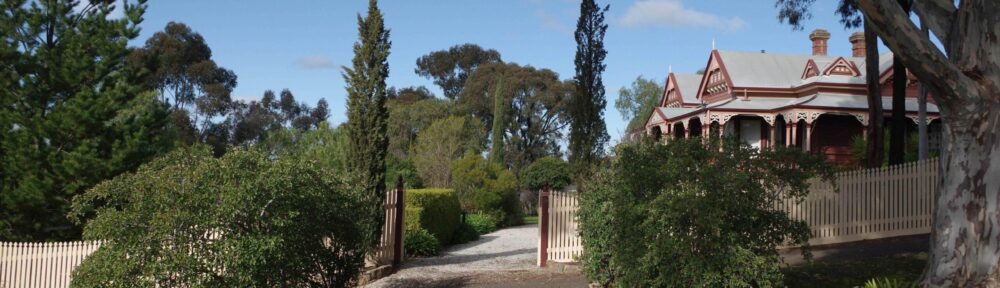
In 1933 Elizabeth Baxter, the widow of local farmer George Baxter, and mother of four now adult daughters, purchased Minilya from Charles Calder. It’s not known why Mrs Baxter purchased the grand house on the hill or if the family continued to refer to it as Minilya as no property name is noted in official documents from that time. The Baxter family were long time residents of Maldon; George and his father had both been miners before the decline in mining when George subsequently took up farming on the edge of town.
Decline –
At the time of her purchase, Maldon was at a low ebb and progress seemed to have passed the town by. It wasn’t until 1936 that Maldon was connected to the State’s electricity grid, reticulated water supply was limited and a reticulated sewerage service was still many decades away. The economy slowly started to improve with the introduction of government-initiated employment schemes in the 1940s and commencement of the Cairn Curran Reservoir project. By 1947 the population had grown to 1,098, and would remain around that number for the next two decades.
Elizabeth Baxter died in 1951 and the property came under the control of two of her daughters as executrices of her Estate. The house was occupied by Baxter family members for some periods after Mrs Baxter’s death. At other times it was vacant and reputedly known as ‘the ghost house’ following sightings of mysterious lights and figures at night according to an item in the Bendigo Advertiser of 6 March 2002. Investigation revealed local children had found a way in and were playing make believe amid the furniture and many household items which remained in place.
As time passed Minilya, along with many of Maldon’s historic buildings, began to fade.
To the outsider the town was becoming somewhat dilapidated as it fell back on its limited resources. Serendipitously, it was this long-lasting downturn which preserved Maldon’s historic buildings as there was no impetus or capital to replace them. This situation had changed by the late 1950s when some key central area buildings were demolished and the sites redeveloped. It was around this time that the National Trust of Australia (Victoria) was first alerted to Maldon’s unique character, its extensive collection of buildings, intact streetscapes, mining relics and landscapes from the 1850s through to the early 1920s.
In September 1964 John Collins photographed Minilya and many other properties in Maldon. Minilya’s numerous shrubs and mature trees are clearly visible in his photograph. Collins was an honorary photographer for the National Trust for over four decades from 1950. The John T. Collins Collection, now in the State Library of Victoria, provides a unique record of Victoria’s diverse architectural heritage as it was at the start of the heritage conservation movement.
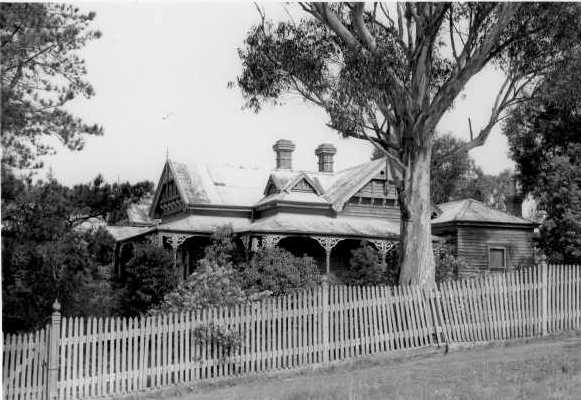
Source: State Library Victoria, John Collins Collection.
Recognition –
Outside interest in Maldon began to increase. Studies of the town’s architecture were undertaken by students from the University of Melbourne’s, School of Architecture in 1964 and 1965. One of those students was Miles Lewis who would later become the doyen of Maldon heritage conservation.
The students’ work, presented in September 1965, was used by the National Trust to support the introduction of a new classification, the Notable Town. The first such classification was applied to Maldon later that year. Maldon’s classification was unusual in that it recognised an ordinary place, and hence the activities and lives of ordinary people, as being historically important. As a matter of interest, it was to be another 50 years before the Notable Town classification was applied again, this time to Tallangatta, the town that was moved in 1956 due to the expansion of Lake Hume reservoir.
Maldon Shire Council was notified of the classification by letter, dated 20 December 1965, from the National Trust’s Chairman of Committee. He noted that the classification meant Maldon was of ‘unique historical interest’ and that it may ‘benefit Maldon tourism’. Thus, with a brief letter and equally brief citation, the values of external experts were to be imposed upon Maldon. Needless to say, there were some interesting times to come as the many associated issues unfolded.
In February 1966 Maldon’s new status as Australia’s first Notable Town became public. Maldon had been noticed and recognised, it was special, and suddenly it seemed that the tourism-led recovery sought by Charles Calder and the Advance Maldon Association over forty years earlier was a real possibility. Visitors flocked to Maldon with many seeking to purchase real estate in town, while entrepreneurs were keen to develop tourism and other businesses which traded on Maldon’s special characteristics.
Protecting Maldon’s historic character –
It soon became evident that without some controls on development, Maldon would be in danger of losing the characteristics which made it notable. A Melbourne-based Maldon Committee was formed by the National Trust in 1968; it was expected to work alongside a local Conservation Committee formed in the same year. Things moved slowly. In 1969 the Trust’s Maldon Committee report, Proposals for the Conservation of Maldon, described Maldon as being at the crossroads; the choice being between becoming a national heritage asset with proper protection, restoration and controlled development or being ‘just another town with a past history’.
This prompted further action from Melbourne, this time from the State government, which invoked an Interim Development Order (IDO) for Maldon’s heritage areas on 1 January 1970. The then planning authority, the Town & Country Planning Board, administered the IDO in Melbourne and planning applications related to the historic areas were decided there, much to the chagrin of many locals. At one point growing community disaffection with the planning controls and the associated bureaucratic process, led to the Maldon Shire Council voting in favour of requesting that the National Trust declassify Maldon.
The classification remained and in 1973 the Maldon Planning Scheme was introduced to replace the Interim Development Order, although planning decisions relating to the heritage areas continued to be made in Melbourne until 1988. At the time, this planning scheme was the most detailed of such schemes applied for the conservation of a heritage locality. The Maldon community was now making history and experiencing the pressures of being the heritage planning ‘guinea pig’ according to author Malcolm Crick in Heritage and Planning in Maldon: A Brief Retrospect, published by Maldon Museum & Archives Association Inc, n.d.
While these new arrangements were being processed by the local community and others, Minilya was unoccupied and slowly deteriorating. Unsurprisingly its grandeur and enduring appeal remained such that it frequently attracted the interest of photographers both amateur and professional. A summary of the Town & Country Planning Board survey of 1970 held by Maldon Museum & Archives, described the house as being ‘weatherboard, with brown walls, unpainted galvanised iron roof, good trees and amenity’.
As the 1970s progressed, the built legacy of Maldon’s gold era became the mainstay of a new tourism-based economy, and further firsts in heritage protection and conservation were introduced. Community enthusiasm for Maldon’s historic buildings and their restoration was now increasing rapidly. At the same time some consideration was being given to putting a demolition order on Minilya. This situation may well have provided the impetus needed to allow the property to change hands, which it did in 1974.
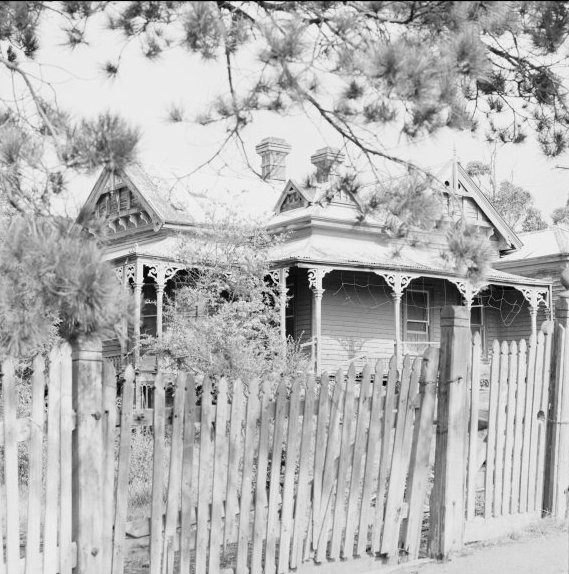
Source: NLA, https://nla.gov.au/nla.obj-152170286 – Wes Stacey archive of architectural photographs, 1968 – 1972.
Regrowth –
On 2 March 1974, The Age newspaper’s Real Estate Editor described Minilya as a ‘mansion-style timber house on the side of a hill … in probably the best position in Maldon’.
When the property was auctioned on 2 March, the historic house and its contents were sold separately. The event drew a large crowd of onlookers and keen buyers chased the many pieces of antique furniture ranging from an over-mantled organ to half-tester iron bed, plus the wide selection of decorative items, bric-a-brac and sundries.
Many locals took this unique opportunity to purchase their own piece of historic Maldon and it’s understood that many of the items sold are still to be found in local homes and collections.
Although the grand house was now in need of restoration, it achieved a good price and seemed destined to play a part in Maldon’s new economy.