Tarrangower transformed:
For many thousands of years, the Tarrangower area has been part of the traditional lands of the Dja Dja Wurrung People who regard the land with deep reverence. For them Country was and is more than a landscape which could sustain them, it is also a place of belonging and a way of believing.
European settlers began arriving in the district from the late-1830s and the disruption of the landscape commenced. The pastoralists acquired vast land holdings, and in the process effectively denied the Indigenous people access to the water and hunting grounds, and disrupted the connection between the people and their Country.
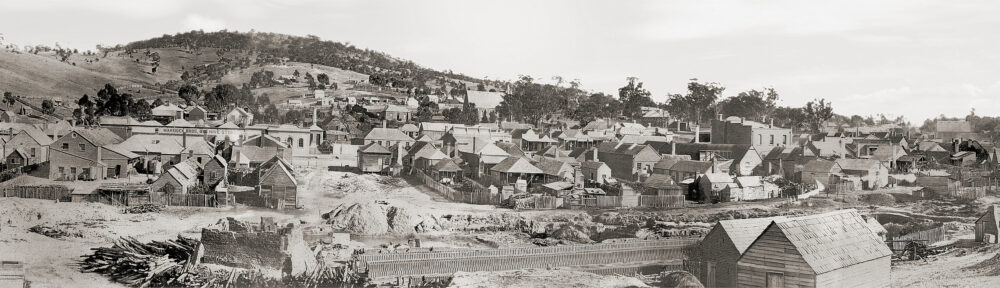
When the Tarrangower gold rush started in late 1853, the change about to be wrought on the landscape and earlier ways of life would have been inconceivable to many, although it was already occurring in many other places across central Victoria. The land around Mount Tarrangower would soon be changed forever: turned upside down and inside out in a feverish quest for gold.
By 1854 the quiet bushland had become unrecognisable with as many as 20,000 gold-seekers reportedly swarming the area. The region had joined the Central Victorian Gold Rush, one of several gold rushes across the globe which would result in mass migrations and immense wealth for the lucky few over the next fifty years.
The government acted quickly to establish a Commissioner’s Camp and on 4 February 1854 gazetted a township to be named Maldon. Land surveys followed. The township was originally surveyed for an area north of the main mining and commercial activity however this area was not successful in the short term as it was deemed too distant from key resources.
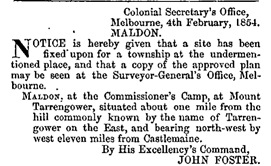
7 February 1854, p. 290.
By 1856 sites in central Maldon were being occupied under annual licences from the Crown. Subsequent land surveys and sales included areas closer to the burgeoning town centre and around the existing diggings and tracks; thus, a more substantial and stable settlement began to emerge.
This coincided with Maldon’s shift from the small claims and ephemeral camps of an alluvial goldfield to the capitalised and labour-intensive requirements of quartz reef mining. The change resulted in the introduction of extensive infrastructure and new technology, plus it attracted a more permanent population base to service the industry, each important in establishing Maldon as a major mining centre.
The Crown land sales gave many people the opportunity to acquire the freehold title to land; a situation quite unfamiliar to most. Many of the land purchases were speculative and development was slow in some residential areas.
When it became clear that the Tarrangower gold discovery would be more than a short-lived alluvial rush, the Maldon town centre developed at a rapid pace. By the late 1850s various services had been established including a hospital, post and telegraph office, schools, a market hall, several churches and the Tarrangower Times newspaper. Banks, numerous hotels and retail establishments completed the offering. By the mid-1860s, there was also a purpose-built Court House, library, and many more businesses producing and selling a vast range of goods and services, plus permanent residences were established as people settled in for the longer term.
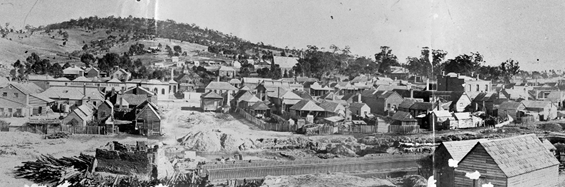
Source: Maldon Museum & Archives, VMLD-2919.
The township of Maldon existed because of gold; its first fifty years spanned the global gold rush era. It was a mining town, run by mining interests. It wasn’t until mining started to decline in the early twentieth century that alternatives, including tourism, began to be explored. No viable alternative was found. After Maldon’s seventy-year golden era ended in the late 1920s the town remained quiet until the 1960s.
Today Maldon retains the charm of that bygone era without the din, danger and economic unpredictability so often associated with nineteenth century gold mining. The wide tree-lined streets host a rich and diverse collection of historic buildings which record Maldon’s recent history and development as part of Central Victoria’s great gold mining narrative.
The story of Minilya, its builder Charles Calder and subsequent owners, would not exist if not for Maldon’s gold and the possibilities that created in the decades before Minilya was constructed. Some explanation follows.
— — —
Permanent settlement:
Lured by the rich gold deposits within Maldon’s quartz reefs, sections of the local population established larger mining operations which made use of technology to reach and process the ore. For these company mines, acquiring the latest equipment was always top of mind and English capital often funded the upgrades.
The rapid development of a more permanent settlement was further encouraged by Crown land sales and the opportunity to acquire the freehold title to land.
The land at the corner of Adair Street and Chapel Street North in Maldon on which Minilya now stands was originally purchased at these sales. Crown Allotments 14 and 15, Section 9, Township of Maldon, were acquired in the name of Sibella Wilkinson in 1857 for a total of 11 pounds, 5 shillings, while Crown Allotment 16 was acquired by Samuel Wilson in 1861 for 6 pounds, 5 shillings.
These lots were some distance from the centre of town, and it would seem that the purchases were speculative as all three lots remained with their original purchasers, and undeveloped, for almost forty years. Even the nearby construction of a hospital, church and school did not encourage development of these and other nearby lots.
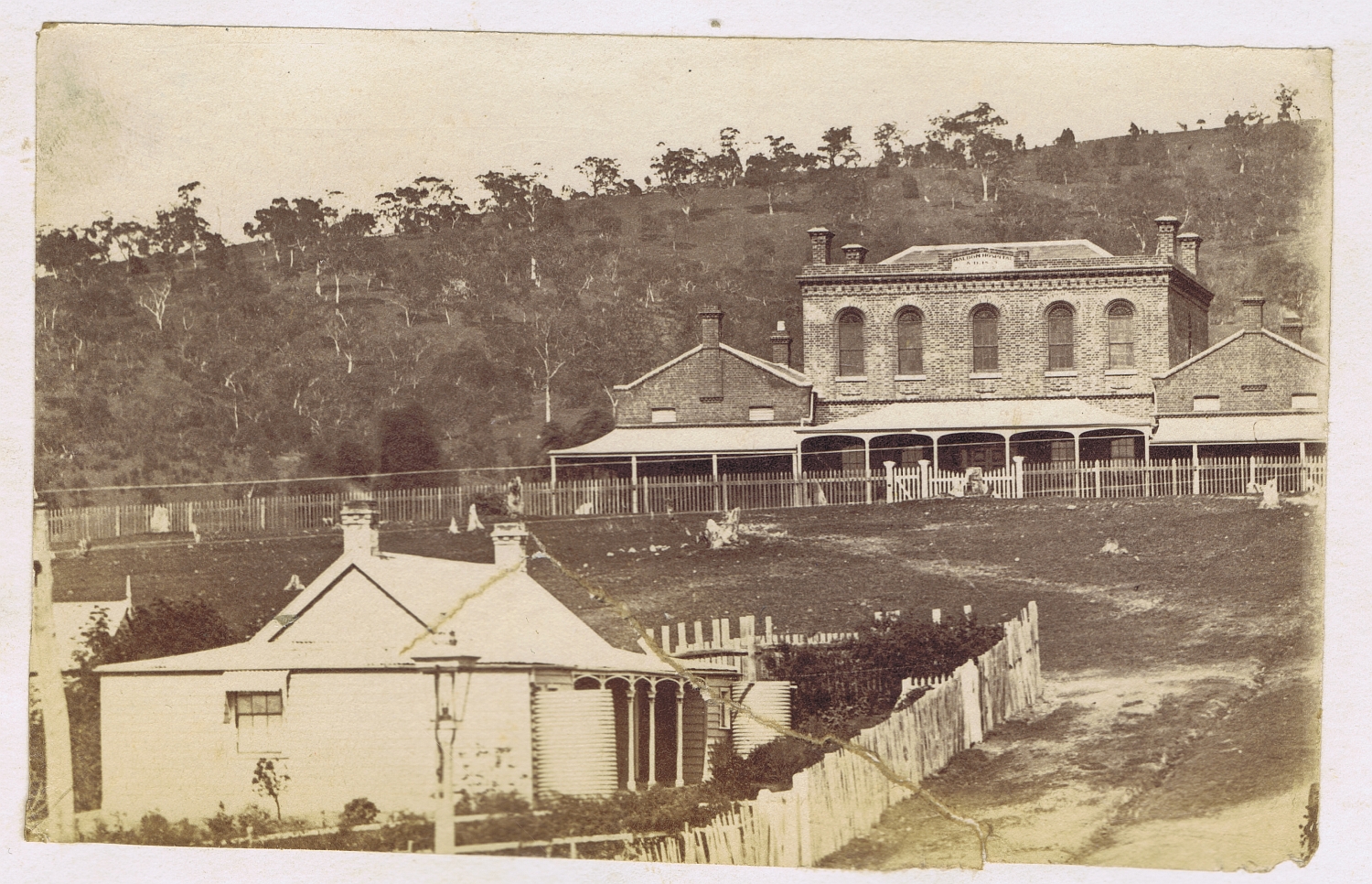
Source: Maldon Museum & Archives, VMLD-4533, Hannay Series.
However, while this land lay idle, other areas of Maldon were developing apace. Recently purchased allotments in the central area now accommodated all manner of business activities in support of the gold mining, and the miners and their families. Businesses and land holdings frequently changed hands as life in this new world presented previously unimaginable opportunities for the lucky few.
Drawn together by gold:
The Calder family on the Central Victorian goldfields –
During these hectic years Thomas Calder, his brother and sister, were among those immigrants who chose commerce rather than mining to support themselves on the goldfields. They first settled and commenced businesses in Castlemaine, part of the Mount Alexander goldfield, and relocated to Maldon in 1857. It was here that Thomas’ highly successful timber yard and ironmongery in the heart of Maldon prospered during the boom years. The business supplied the building trades and mining companies with materials and the latest equipment; it continued in Calder family hands for over seventy years.
Thomas Calder married Anna Harvey at Launceston, Tasmania in 1861. He and Anna subsequently resided in the residential quarters at the rear of the ironmongery until their new home, Roseneath was ready. The house was built in several stages and reflected the family’s changing needs, tastes and aspirations. It is believed that Roseneath was named after Anna’s home village located on the banks of the Firth of Clyde in Scotland.
Thomas and Anna had nine children; the second being Charles Lewis Calder (1863-1942), who would later operate the family business and develop Minilya. Charles spent his childhood in Maldon and may have spent some of his teen years at Horton College, a private school at Mona Vale, Tasmania, as the family had continuing links in the area.
The Calder family was well-connected politically and socially with visitors from all walks of life regularly hosted at Roseneath; this goldrush immigrant family was aspirational, hard working and determined to succeed. Members of the family were also widely known for their charitable works. The activities and achievements of Calder family members were often mentioned in local newspapers; including Charles’ love of tennis and fine singing voice. The family is also mentioned in Henry Handel Richardson’s memoir, Myself When Young (Heinemann, London, 1948); the Richardson family were close neighbours and regular visitors to Roseneath between 1880 and 1887.
Thomas Calder’s business and investment activities continued to prosper. He invested in local mining companies and acquired numerous parcels of local land, including Crown Allotments 14 and 15 in Adair Street which he purchased from Sibella Forster, née Wilkinson for twenty pounds in 1896.
Charles’ movements in early adulthood have not been tracked, however his sister Lillian’s diary entries from 1887 locate him in the Colony of Western Australia seeking gold and adventure. It was early days for the Western Australian gold rush; the peak was to come with the discovery of the Coolgardie-Kalgoorlie fields in 1892-3. This discovery drew men from across Australia and the world, consequently doubling Western Australia’s population in just four years.
At one point in the 1890s Charles was managing the ‘Wheel of Fortune’ gold mine at Mount Magnet, a gold rush town with a similar genesis to Maldon. It was against this backdrop that he developed the business acumen and leadership skills which served him well in later life.
The Hearman family in Western Australia –
It was probably during Charles’ time in the Colony of Western Australia in the later 1890s that he met his future wife, Mary Isabel Hearman, the daughter of a wealthy Perth merchant and pastoralist. Mary’s parents, William and Eliza Hearman, arrived in Fremantle from London in January 1879. They ran a highly successful wholesale and retail drapery and clothing store in Perth from mid-1879 and mixed with Perth’s elite. William Hearman also sought grazing land in Western Australia and eventually took up a pastoral lease in the Gascoyne region. This property was Middalya Station situated on the Minilya River.
By 1894 Hearman had established a store in London and members of the family regularly travelled between the Colony and England. During the 1890s Mary returned to England to further her education. In 1896 the Perth business was sold, although the Hay Street property was retained. By 1897 William’s son Douglas was operating the Middalya pastoral lease and Hearman family members continue to do so.
Charles Calder & Mary Hearman –
On 27 June 1899 Charles married Mary Hearman at St George’s Cathedral, the principal Anglican Church in Perth. It was indeed a fashionable wedding with the ceremony performed by the Bishop of Perth before a large group of personal acquaintances of the bride’s parents, plus several attendees who had travelled from Victoria. The West Australian newspaper of 29 June 1899 carried a lengthy report on the event, and the guest list reads as a who’s who of Perth’s elite in the day.
After their marriage, Charles and Mary moved to Maldon. Charles found plenty of local interest in his mine management skills and he assisted his father in the family business.
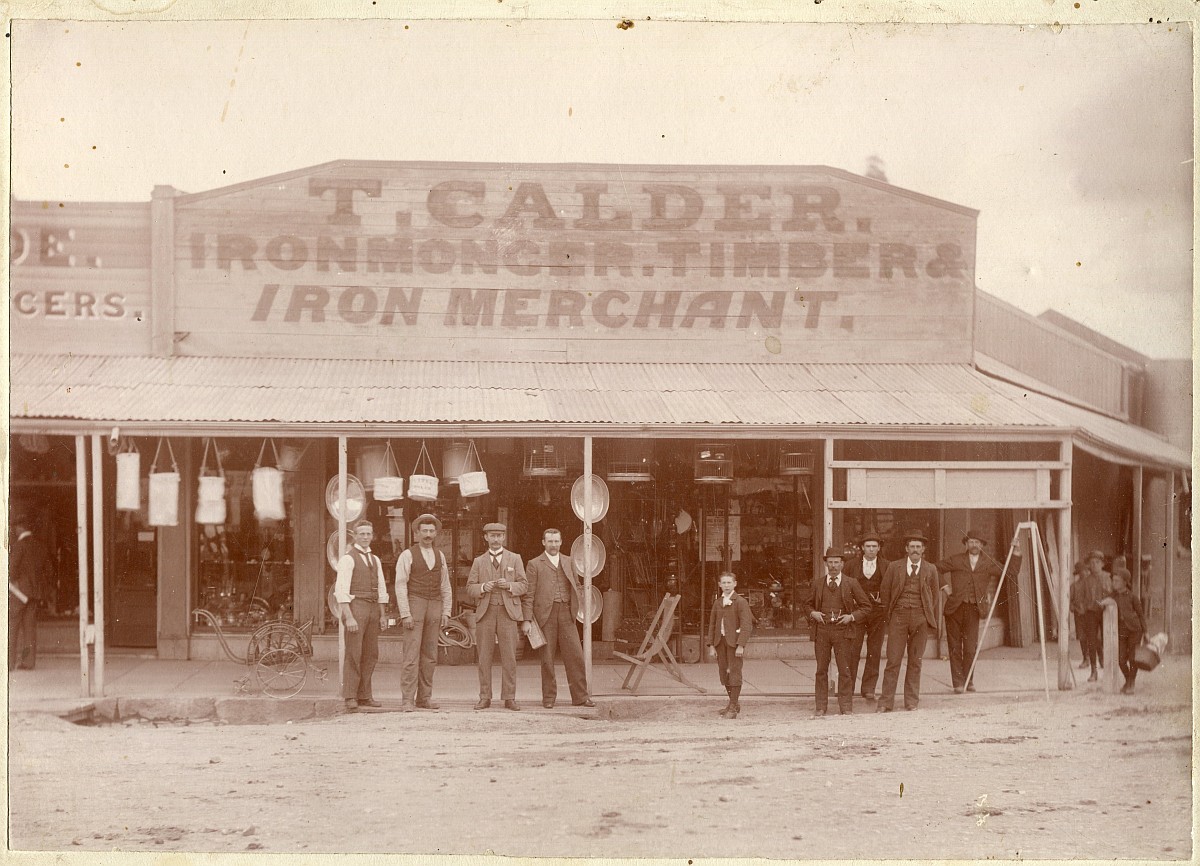
Source: Maldon Museum & Archives, VMLD-4701.
He and Mary also set about establishing a home. In February 1900 Charles purchased Crown Allotment 16 from the Wilson family for thirty pounds, and in April 1900 Thomas Calder gifted the adjoining lots to his son.
With a fine parcel of land now in hand, the development of Minilya was one step closer. The story also has an intriguing link to the Otago goldfields on New Zealand’s South Island.
The Otago goldfields connection –
Across the Tasman Sea, another gold rush had been playing out on New Zealand’s South Island. The Otago field, inland from Dunedin, saw that city reap the benefits from a period of great prosperity from the 1860s. The Otago connection with Maldon was strong; at the start of the rush numerous Maldon residents joined in, later mine managers and workers regularly travelled between the two gold fields as fortunes on their home fields fluctuated.
In the 1880s, as New Zealand’s economy and the Otago field declined, some permanent migration resulted; architect, Louis Boldini was one of those who relocated from Dunedin to Victoria, first to Melbourne and later to Maldon, where his commissions included Minilya.
— — —
Louis Boldini – an architect of renown:
Boldini’s story makes for thought-provoking reading and some highlights are recounted here. To learn much more about Boldini’s life and work read David Murray’s highly informative blog Built in Dunedin.
Boldini was born in Ferrara province, Italy in 1828; the eldest son and second of thirteen children. His early career saw him practise civil engineering, and teach at a local technical institute. Boldini’s obituary in the Tarrangower Times 14 October 1908 noted that as a young man he had been a supporter of Garibaldi, the revolutionary who fought for Italy’s independence and political unification in the mid-1800s.
In 1875, following the death of his wife Adelina, Louis (Luigi) Boldini, along with his sons, Walter (Gualterio) aged twelve, and Alfred (Alfredo) aged seven, emigrated to Dunedin, New Zealand. There were very few Italian-born people in Dunedin at this time and this may explain the anglicisation of their first names.
In Dunedin, Boldini soon established himself as one of the city’s leading architects; designing numerous grand buildings, in particular hotels and office buildings. His façade compositions featured classical forms and intricate details, and construction was principally in stone or rendered brick. At the time he was the only Continental European architect in a profession dominated by men from Scotland and England. The AMP Building completed in 1888 was his penultimate commission in New Zealand.
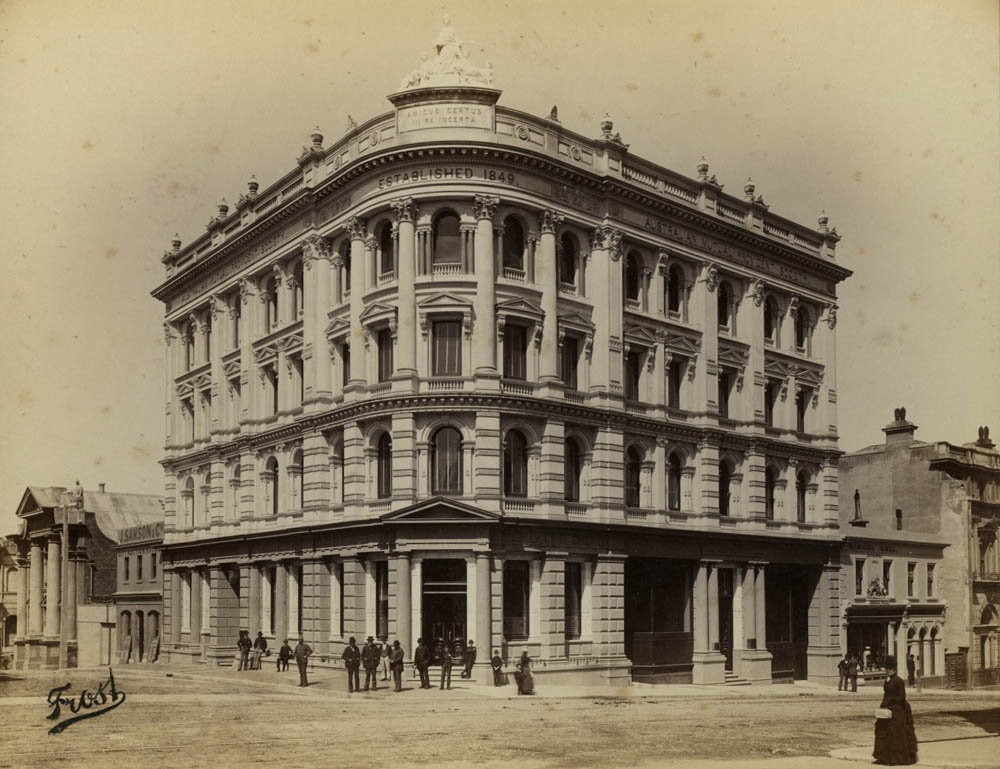
Image: Frost, (Toitu / Otago Settlers Museum 32-49-1)
Throughout the 1880s the New Zealand economy, and consequently design work, slowed. When offered a commission by C. W. Chapman to design Karori, a summer retreat on Mount Macedon, Victoria in 1888, Boldini and his sons emigrated to Melbourne whereupon he set up practice in Little Flinders Street (now Flinders Lane).
In 1890, construction commenced on the most elaborate, and largest, of his works in Victoria, the magnificent Braemar Guest House on the northern slopes of Mount Macedon. Both Karori and Braemar were exuberant leisure-oriented timber structures and quite different from Boldini’s Dunedin commissions.
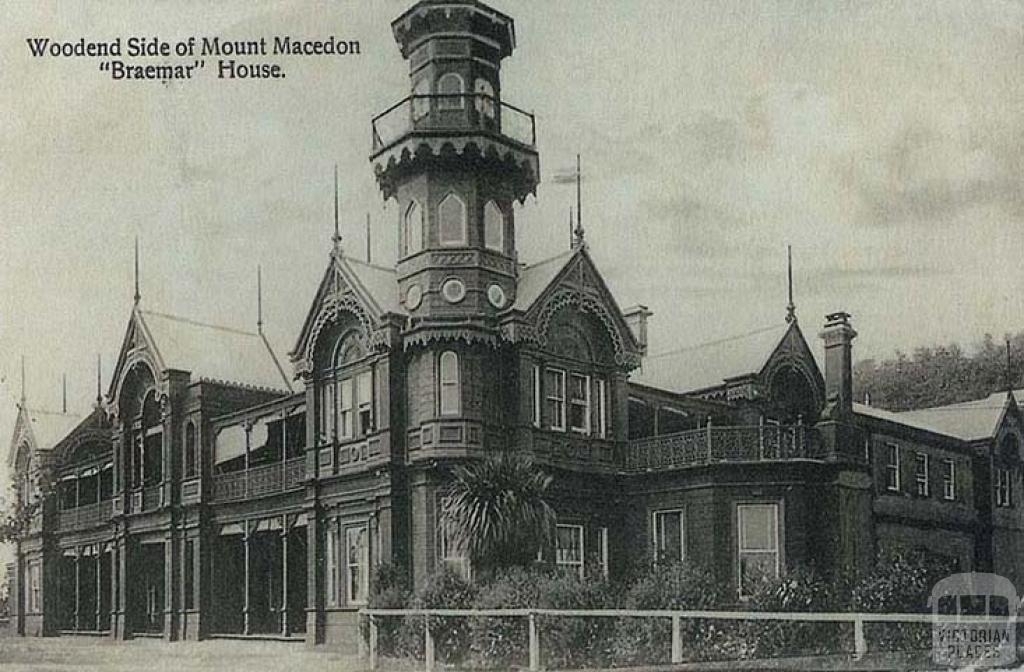
His designs for the Mechanics’ Institute in Woodend (1893) and the Hepburn Springs Bath House (1894) saw a return to traditional masonry materials.
Boldini moved to Maldon in 1895 perhaps drawn by Maldon’s latest mining boom which ran counter to the severe depression which was causing the collapse of private and public investment elsewhere. Also, there was a large Swiss-Italian population in the vicinity.
He established an office in High Street at the heart of the civic precinct, directly opposite the Maldon Shire offices and public gardens, and he is recorded as living in Chapel Street, Maldon on the 1901 Electoral Roll. Louis Boldini had arrived in Maldon at an opportune time and much design work came his way. Over the next thirteen years he designed some of the town’s most notable buildings.
His major local works include Maldon Hospital façade reconstruction (1896-07), Charles Calder house – Minilya (1900), McArthur house (1903), Scots’ (Presbyterian) Church (1905-06), Phoenix Building (1906), and Maldon Hotel (1907-09). Maldon’s prosperity in the early 20th century is reflected in the substantial buildings constructed between 1895 and 1912; a large proportion of these are directly attributable to Boldini.
On 27 February 1908 the Bendigo Advertiser reported that Boldini had recently been appointed a Life Governor of Maldon’s Athenaeum Library, a prestigious recognition of his services to the organisation.
He was still actively designing buildings at the time of his death in October 1908. He died in the Maldon Hospital, literally surrounded by some of his most significant local works. His funeral service was held in Maldon’s Scots’ Church, a building he had designed some three years earlier.
Although Louis Boldini is buried in an unmarked grave at Maldon Cemetery his substantial built legacy endures and his work continues to be appreciated by many in Victoria and New Zealand.