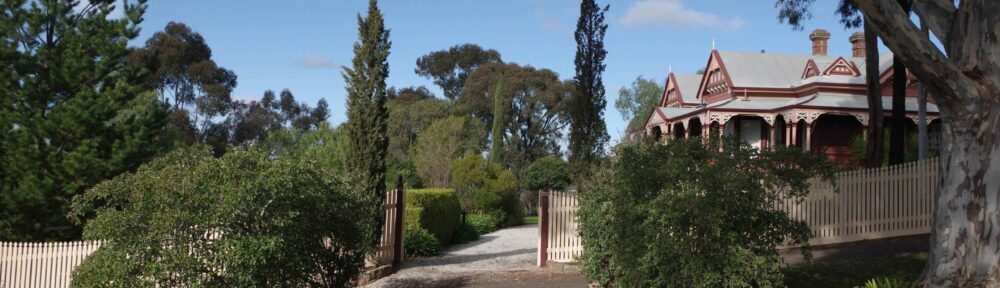
From 1974 a succession of owners, each with their own reasons for purchasing Minilya, brought the house and gardens back to life. Whatever their motivation, we have each of them to thank for contributing to the preservation of the wonderful place which subsequent owners and the community have been able to enjoy.
All the while Maldon continued to attract visitors and they continued to photograph the grand house on the hill. One photographer methodically recorded each face of the building and forwarded the images to the author some thirty years later; these images now provide a valuable record of the property’s design details. Others simply took a few snaps as they were walking by.

Source: Minilya House & Garden Archive.
That large tree trunk in the foreground above is what remains from the sugar gum, Eucalyptus cladocalyx, visible in John Collins’ photograph of September 1964.
March 1974 –
Minilya was purchased at auction on 2 March 1974 by a couple from Melbourne; they were the first out-of-town owners in the property’s 74-year history. Whether it was the prospect of restoring Minilya to its past splendour or some other reason which attracted the new owners is not known, however progress was slow and concerns about Minilya’s future continued.
In November 1975 the National Trust publication Trust Newsletter reported that, although the house had been sold at auction in the previous year there was still ‘no evidence of any external preservation or restoration’.
During 1976 the unoccupied house was used as a location for filming several scenes of the movie Break of Day; Minilya was now a movie star. Some minor work was done to rejuvenate and tidy several areas prior to filming. The south side verandah and several room interiors featured. The kitchen and butler’s pantry are especially fascinating to see in their largely original condition.
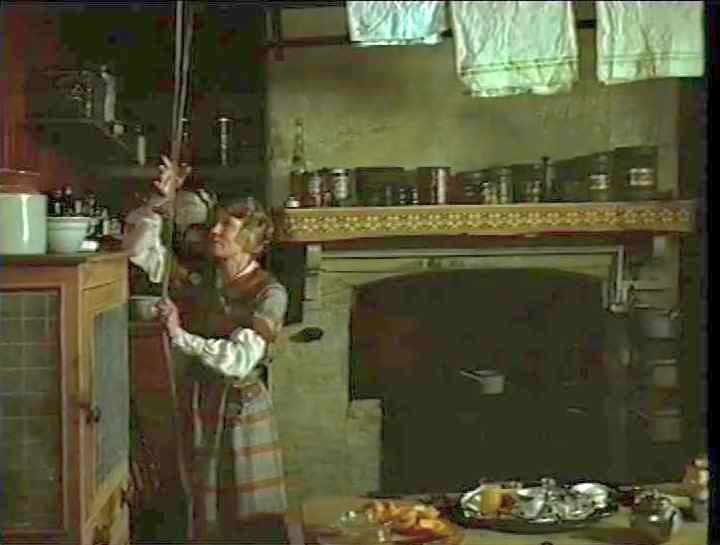
Filming began in April 1976 and was completed in around five weeks. The movie was released on 31 December 1976 to much local fanfare. However, unlike the production company’s earlier work, Picnic at Hanging Rock, this movie did not fire at the box office, perhaps a sign of the economic times or changing audience interests.
Minilya had been in original condition when purchased in 1974 and apart from the minor retouching remained so when resold in 1976.
June 1976 –
Minilya’s next owners, a couple from Bendigo, took possession in June 1976 by which time they had already had plans for additions and alterations to the north section of the rear wing, plus revised laundry arrangements drawn up and submitted to the Town & Country Planning Board. Within 12 months, both the extensive restoration work and additions were well underway as shown in the following image from the Maldon Conservation Study,1977.

Source: Maldon Conservation Study, Jacobs Lewis Vines, November 1977.
The Maldon Shire Council was now actively encouraging heritage protection. This was likely influenced by government support in the form of the Maldon Conservation Study, Jacobs Lewis Vines, 1977, which was developed to facilitate the implementation of the local Planning Scheme, plus the introduction of an onsite Architectural Advisory Service and Restoration Fund. The advisory service in particular was a highly successful first in heritage conservation in Australia.
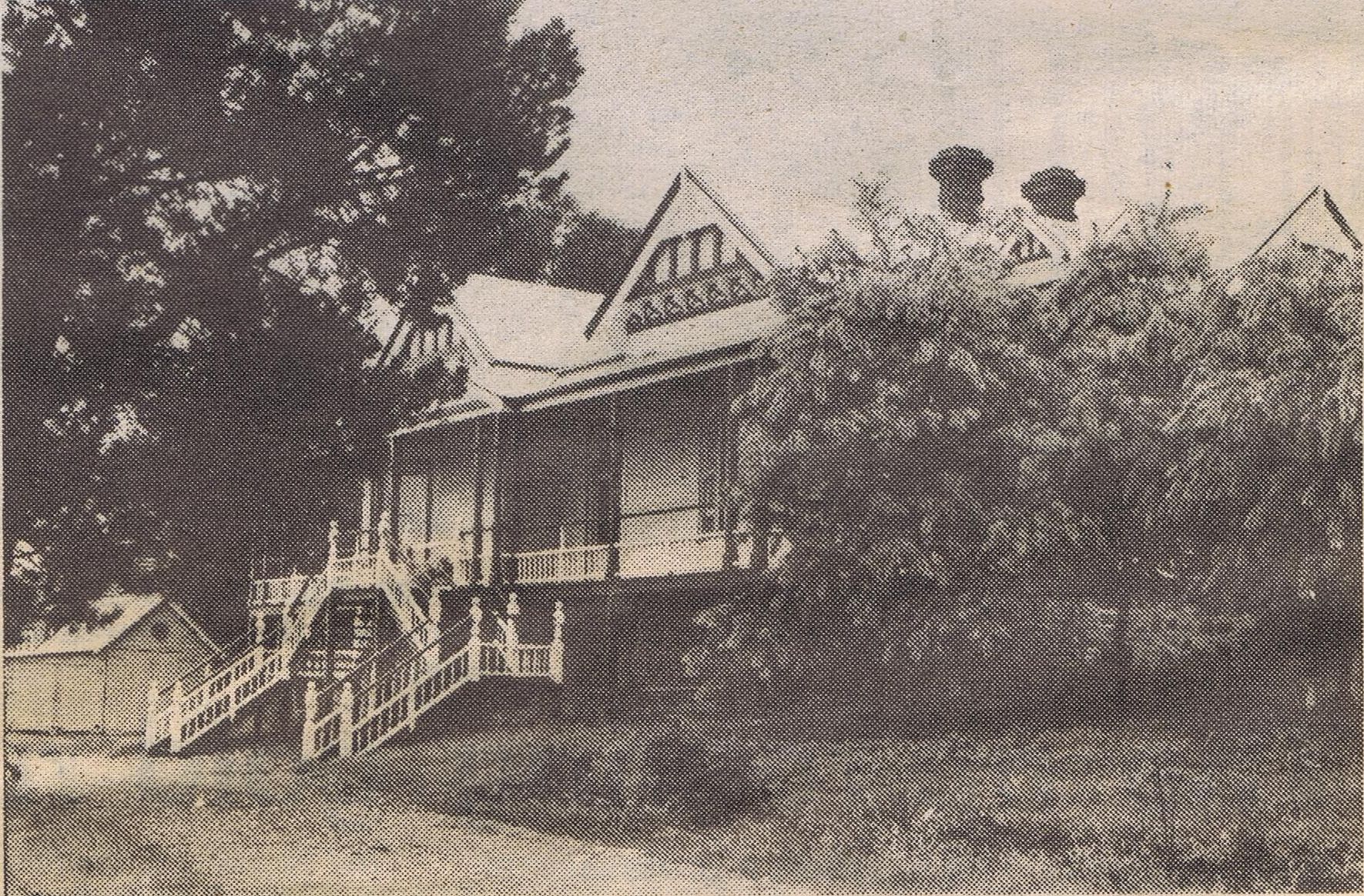
Within two years the exterior of Minilya had been restored where possible and reconstructed where needed, and its historic form and decorative woodwork could once again be appreciated by all. It’s not known why the traditional short corrugated iron roofing sheets were replaced with long sheets of Zincalume coated steel or why the original ogee profile guttering and acroteria were not reinstated given their pleasing appearance and tendency to ‘finish’ street-facing verandah corners. The addition of French doors to the north wing opened that area of the house to the wide return verandah.
During this period, Minilya’s original exterior paint scheme was radically altered from its original earthy brick-red body and highlights in multiple muted shades, to an off-white body with some brown highlights. The altered colour scheme was approved by the responsible authorities of the day. This approval was given while the Maldon Conservation Study was being prepared; the study’s authors later described this new scheme as ‘inappropriate’ (Part 1, page 22), however it remained off-white with brown trim and then white with green trim until 2010.
Source: A town comes back to life, Golden City Gazette, 27 September 1978, page 14.
While restoration work was also carried out on the interior, the floor plan remained unchanged apart from the addition of an extra room on the north end of the ‘guest’ wing. Services in the bathroom and kitchen were sympathetically updated, while the pantry with its historic cabinetry and servant’s bell system remained unchanged. The old laundry room which included the earth closet, was located on ground level adjacent to the original scullery. The laundry was now modernised, the toilet upgraded and relocated to the main bathroom and the rest of the space converted to a mud-room.
The surrounds also received some attention; fences were replaced and driveways reestablished. Most of the sugar gums on the western and upper northern boundaries were felled, while the historic Monterey pines and the pepper corn trees continued to flourish.
Thanks to a decade of work by these owners, Minilya was once again the grand house on the hill.
In late 1986 the house was advertised for sale. Keen purchasers bought the property prior to auction. On 4 February 1987 a local newspaper, The Maldon Post, reported the sale price as being ‘more than any other sale in Maldon.’ The future was now looking bright; Minilya was to become a delightful haven away from the hustle of the ‘city’ and Maldon would continue to thrive.